
Key points at a glance
- Ticks are external parasites that attach to a cat’s skin and feed on its blood
- They can transmit certain diseases and cause local irritation, and in heavy infestations may even contribute to anemia
- After a walk or any outdoor access, it is advisable to check the cat’s coat regularly and remove any tick promptly with a tick remover
- Appropriate parasite prevention based on the cat’s lifestyle helps reduce the risk of infestation
What is a tick?
A tick is a small parasite that feeds on the blood of animals, including mammals, birds, and sometimes even reptiles and amphibians. Ticks are found in many environments, including forests, meadows, parks, and gardens.
Ticks go through several life stages: egg, larva, nymph, and adult. They need a blood meal at each stage in order to progress to the next one. They are external parasites, meaning they attach themselves to the skin of a host and feed on its blood. Ticks are often found in wooded, grassy, and humid areas, where they can easily latch onto passing hosts.
How much does treatment for a tick-related illness in a cat cost?
The cost depends on the disease involved, the tests needed to identify it, and the cat’s overall condition. Early treatment usually helps limit the risk of complications and hospitalization.
| Procedure or treatment | Indicative price without insurance |
|---|---|
| Veterinary consultation | €30 to €60 |
| Blood test | €60 to €130 |
| Blood smear | €20 to €50 |
| PCR test or specific analysis | €70 to €150 |
| Medication | €20 to €100 |
| Hospitalization | €50 to €150 per day |
| Follow-up consultation | €30 to €60 |
The final bill can therefore range from around a hundred euros for a straightforward case to several hundred euros when hospitalization or additional tests are needed. Depending on the policy, these veterinary costs may be covered by cat health insurance.
What does a tick look like on a cat?
A tick can look different depending on its stage of development.
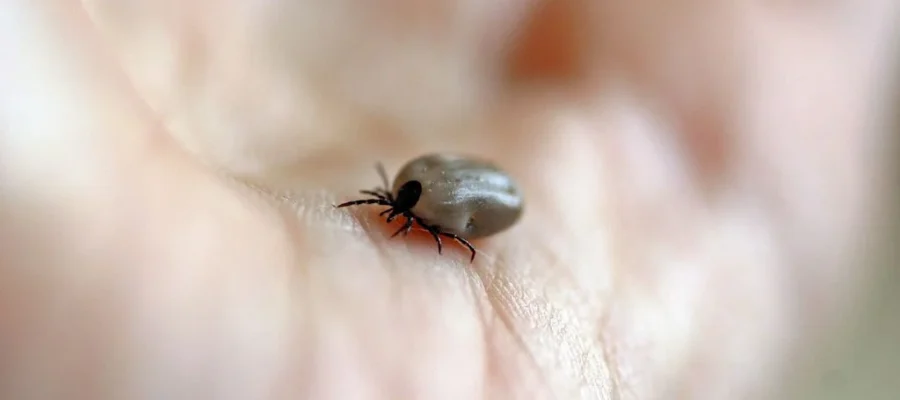
Ticks can be very small, especially in the early stages of development. They may look like tiny black or brown dots on the cat’s skin. Once they have taken a blood meal, they become “engorged” and therefore much larger, reaching up to 1 cm.
When attached to a cat’s skin, they are usually oval or rounded. As they feed, ticks often become dark or brown in color. They may appear motionless while feeding. They can also move slowly if they are not yet firmly attached.
Ticks often attach in places where the cat’s skin is thin, such as around the ears, the neck, the paws, and under the tail.
Here is a table summarizing the main differences between a tick and a flea on a cat:
| Characteristic | Tick | Flea |
|---|---|---|
| Size | 1 to 3 mm (unfed) up to 1 cm (engorged with blood) | About 1 to 4 mm |
| Shape | Oval, swollen body that stays still | Laterally flattened, slim, and agile body |
| Color | Brown, grayish, or black (turns light gray when engorged) | Dark brown or black |
| Movement | Still, firmly attached to the skin | Very mobile, jumps quickly from one point to another |
| Location | Hard-to-reach areas: head, neck, ears, between the toes | Everywhere on the body, especially the lower back, belly, and neck |
| Feeding behavior | Bites and remains attached for several days to feed on blood | Bites briefly and moves around frequently |
| Touch | Hard and raised, like a small grain or wart | Almost impossible to feel, and jumps away at the slightest contact |
| Droppings | No visible droppings | Small black specks (flea dirt) in the coat, visible with a fine comb |
When is tick season for cats?
Ticks are especially active when temperatures are mild and humidity is sufficient. In France, the highest-risk periods are mainly spring and autumn, although ticks may be present for much of the year.
Cats with outdoor access are more exposed, especially when they spend time in tall grass, brush, gardens, or wooded areas. With increasingly mild winters, ticks may also be encountered outside the periods traditionally considered risky.
It is therefore recommended to check the cat’s coat regularly, especially around the head, neck, ears, and between the paws, and to use suitable parasite prevention on veterinary advice.
What danger do ticks pose to a cat?
Ticks can pose several risks to cats.
Disease transmission
Ticks can transmit various serious diseases to cats when they feed on their blood, including bartonellosis. This disease can cause fever, anemia, and clotting disorders.
Skin problems
Some cats may develop allergic reactions to tick bites, leading to severe itching, skin irritation, and sometimes secondary skin infections.
Anemia
Ticks feed on their host’s blood, which can cause blood loss in heavily infested cats and lead to anemia if the situation is not treated quickly.
Can ticks move from cats to humans?
When a cat has ticks, they can contaminate its environment and therefore infest humans nearby. They are also dangerous for people, because they can transmit different diseases:
- Lyme disease: This is the most common tick-borne disease in France and Europe. It is caused by a bacterium of the Borrelia genus. Symptoms can vary widely and include a characteristic circular rash, fever, headaches, joint and muscle pain, severe fatigue, and swollen lymph nodes.
- Tick-borne encephalitis (TBE): This is a viral infection that can affect the central nervous system. Symptoms can be serious and include fever, headaches, vomiting, and neck stiffness.
What are the symptoms of tick-borne diseases in cats?
Diseases transmitted by ticks can be difficult to recognize in cats because they often cause nonspecific symptoms that are common to many other conditions. Some infected cats may not show any symptoms at all. When clinical signs do appear, their severity depends on the agent involved, the cat’s general health, and any concurrent illnesses.
The main signs to watch for are:
- Fever in cats, sometimes high
- Unusual tiredness, lethargy, or weakness
- Reduced appetite or refusal to eat
- Weight loss
- Dehydration
- Pale mucous membranes, especially the gums
- Faster breathing or heart rate
- Enlarged lymph nodes
- Pain, stiffness, or limping
- Painful or swollen joints
- Conjunctivitis or other eye problems
- Vomiting or diarrhea
- Yellowing of the mucous membranes or skin
- Unusual small bleeds, such as nosebleeds or tiny red spots on the skin
- Breathing difficulties
- Less commonly, neurological signs such as loss of balance, tremors, or seizures
In feline anaplasmosis, the main reported signs are fever, reduced appetite, and lethargy. Dehydration or conjunctivitis may also occur. More rarely, the cat may have joint pain, lameness, swollen joints, enlarged lymph nodes, or nosebleeds.
According to a European study of 1,015 cats tested between 2017 and 2022, 7.5% were PCR-positive for Anaplasma phagocytophilum. Infections were significantly more common in summer than in winter.
Infections caused by bacteria of the Ehrlichia genus may also lead to fever, loss of appetite, and marked fatigue. Some cats also show pale mucous membranes, joint pain, enlargement of the lymph nodes or spleen, or, more rarely, clotting problems that cause small bleeds.
Some tick-borne diseases can also cause anemia. In that case, an owner may notice that the gums become unusually pale, the cat is less active, or it seems to become short of breath quickly. When anemia is severe, the heart rate and breathing rate may increase.
Cytauxzoonosis can take many forms. Infections reported in Europe are sometimes asymptomatic or mild, but severe cases are also described. Affected cats may develop fever, marked lethargy, loss of appetite, pale mucous membranes, anemia, vomiting, diarrhea, or abdominal pain. Breathing difficulties, jaundice, and neurological signs have also been reported in severe cases.
It is also important to remember that finding a tick on a cat does not mean the cat has contracted a disease. Conversely, a tick may have detached before the first symptoms appear, so the owner does not always notice the bite that led to the infection.
After finding a tick on a cat, it is advisable to monitor the cat’s general condition over the following days and weeks. Unusual fatigue, fever, reduced appetite, pale mucous membranes, lameness, or any other change in behavior should prompt a veterinary visit, especially if several symptoms appear at the same time.
The veterinarian can then perform a clinical examination and, if needed, blood tests, a smear, or specific tests such as PCR to look for certain tick-borne infectious agents. Symptoms alone are usually not enough to identify the disease involved with certainty.

It is important to know how to remove a tick from a cat to help avoid infection or a transmissible disease. Make sure you have the right tools and handle the tick carefully so that no parts are left behind in the cat’s skin. If you have any difficulty or any concerns, do not hesitate to contact your veterinarian for help.
Removing a tick with a tick remover
- Make sure you have a tick remover designed specifically for ticks and clean latex gloves.
- Place the tick remover around the tick, as close to the cat’s skin as possible.
- Gently turn the tick remover counterclockwise. The tick should detach on its own and remain caught in the tool.
- Continue turning until the tick is fully detached.
- Clean and disinfect the bite area.
- Watch the bite site and your cat’s behavior carefully over the next few days.
Want to protect your cat in case of illness or accident? Speak by phone with a Santévet advisor to find coverage options suited to your pet.
How do you remove a tick from a cat without a tick remover?
Put on latex gloves to avoid direct contact with the tick and prepare a clean pair of tweezers. Grasp the tick firmly close to the cat’s skin with the tweezers. Rotate the tick until it comes away, being careful not to crush it or leave any part behind in the skin.
After removing the tick, wash the bite area with soap and water, then disinfect it with an antiseptic.
Keep an eye on the bite area and on your cat’s overall behavior. If any unusual symptoms appear, consult a veterinarian quickly.
Is it serious if the tick’s head remains in the cat’s skin?
It is best to avoid leaving the tick’s head in the cat’s skin, but if it happens, it is not necessarily a medical emergency. The important thing is to monitor the bite area for any signs of infection. In most cases, the cat’s body will naturally expel the remaining part of the tick.
If you notice signs of infection such as redness, swelling, excessive heat, pus discharge, or unusual behavior in your cat, make an appointment with a veterinarian.
How long does a tick stay attached to a cat?
In general, a tick can remain attached to a cat for several days, or even several weeks, feeding on its blood.
Healthvet tip: Never use a parasite treatment intended for dogs on a cat. Some substances found in dog products, especially permethrin, are highly toxic to cats. Ask your veterinarian to help you choose a suitable anti-tick protection.
Can a tick on a cat fall off by itself?
A tick may detach from a cat on its own once it has had its fill of blood. After completing its meal, it may simply drop off the host animal. However, this can take anywhere from several days to several weeks depending on the tick’s stage of development and other environmental factors.
What treatment helps protect cats against ticks?
Your veterinarian can suggest a prevention plan adapted to your pet’s lifestyle. Several types of parasite control products exist for cats: spot-on pipettes, collars, tablets, sprays, and more. They may also help protect against cat fleas and worms.
In short, ticks are external parasites that can be dangerous for both cats and humans. That is why it is so important to protect your pet properly with suitable parasite control products.
A box of Credelio for cats usually costs around €25 to €35 for 3 tablets, depending on the dosage and the retailer. This antiparasitic medicine is prescription-only in France.
An antiparasitic collar against fleas and ticks usually costs €20 to €35 per unit, depending on the brand and how long it remains effective. Some models provide protection for several months.
Anti-tick spot-on treatments for cats usually cost €10 to €25 for a box of 3 to 4 pipettes, depending on the product. You should choose a parasite control product specifically made for cats.
Products marketed as natural sprays do exist, but their effectiveness varies. Be careful with essential oils, as some can be toxic to cats. It is better to use a suitable parasite treatment after veterinary advice.
Sources:
- Springer A, et al. Year-round tick exposure of dogs and cats in Germany and Austria: results from a tick collection study. Parasites & Vectors. 2023.
- Schäfer I, et al. Molecular Detection of Anaplasma phagocytophilum in Cats in Europe and Associated Risk Factors. 2024.
- Schäfer I, et al. Anaplasma phagocytophilum infection in cats: A literature review to raise clinical awareness. Journal of Feline Medicine and Surgery. 2020.
- Carli E, et al. Cytauxzoon sp. infection in the first endemic focus described in domestic cats in Europe. Veterinary Parasitology. 2012.
Santévet
Leader in pet health insurance
Photos: 123RF
latest posts published

Dog Supplies: Essential Checklist Before Adoption (2026 Guide)

How to Understand Your Hamster’s Behavior

How to Feed an Unweaned Kitten –

Medium-Haired Cats: Breeds, Temperament, and Prices – Cat Breeds

When and How to Find an Emergency Veterinarian

Chocolate Labrador: This Secret Could Save Its Health

What Should I Do If My Dog Breaks a Leg?
The Modern Challenges Facing Farmers Today –

Healthy Dog: How to Spot the Key Warning Signs