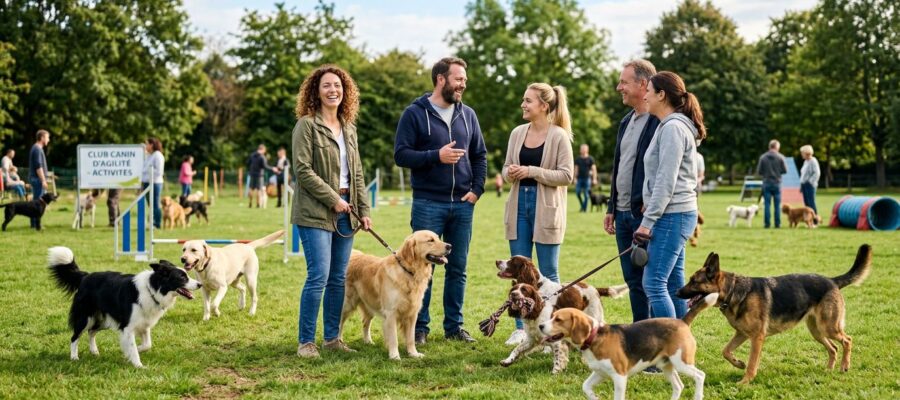
Joining a dog club is rarely a trivial decision. Most people come first and foremost for their dog—to teach it how to walk on a leash, stay calm around other animals, and respond to basic commands. But what no one really says before you walk through the gate is that these clubs have a remarkable way of turning complete strangers into close friends.
Dog socialisation is usually the starting point, and it remains essential. A puppy that learns how to interact with other dogs and people from an early age is far more likely to develop stable, balanced behaviour. Around that educational mission, however, something much larger has grown: a real social ecosystem built on shared walks, competitions, friendly gatherings, and genuine mutual support among owners.
In France, there are several thousand dog clubs affiliated with the Société Centrale Canine (SCC). Every week, tens of thousands of owners meet there, whatever the weather. That is no coincidence. These places answer a deep human need: the need to belong to a community that shares the same passions, the same challenges, and the same small victories.
This article looks at why dog clubs have become, for many people, much more than a place to train a dog.
The role of socialisation in every dog club
Why dog socialisation starts at the club
A poorly socialised dog can become anxious, aggressive, or, on the contrary, overly fearful. A dog club provides a structured setting in which the animal is gradually exposed to a wide range of situations: dogs of different breeds and sizes, children, adults, noises, floor surfaces, and obstacles. That progressive exposure, guided by trained instructors, can speed up behavioural development considerably.
Group sessions are especially valuable. They teach the dog to focus on its owner even when surrounded by distractions, a skill that is difficult to build alone at home or in the garden.
The socialisation of owners: the real secret
What dog club brochures rarely mention is the mirror effect. While the dogs learn to coexist, their owners do exactly the same. People meet every week in the same place, see the same faces, and share the same concerns. Conversations begin with questions like “How did he sleep this week?” and often end up touching on work, family life, and doubts.
Those bonds form naturally, without any effort. The dog becomes a social bridge, a role it plays just as effectively outside the club.
Activities that go far beyond obedience
What do you actually do in a dog club?
Modern dog clubs offer a much wider range of activities than basic obedience training. Some of the most common include:
- Agility, where the dog runs through obstacles while following its handler’s cues. It is a physical and mental discipline that requires real teamwork between the pair.
- Canicross, which combines running with a dog attached to an elastic leash. It is ideal for active owners.
- Treibball, a German-origin activity in which the dog pushes large balls toward a goal by following its owner’s visual signals.
- Mantrailing, where the dog follows a scent trail to find a person.
- Trick training workshops, focused on teaching tricks and more complex behaviours in a playful, relaxed atmosphere.
Each activity creates its own social dynamics. Agility enthusiasts have their competitions, their terminology, and their pre-session rituals. Canicross fans share forest outings. These micro-communities within the club strengthen the sense of belonging even further.
Competitions: when rivalry brings people together
How dog competitions create lasting bonds between enthusiasts
Dog competitions—whether obedience trials, agility events, shows, or ring sports—are defining moments in the life of a club. They mobilise the whole community: the competitors, of course, but also the volunteers, the companions, and the curious onlookers.
Preparing for a competition together creates a powerful group dynamic. Training becomes more serious, advice is exchanged, and motivation spreads naturally. On the big day, the pride is not only individual; it is collective. Even those who are not competing come to cheer, take photos, and comment on the performances.
These events are also an opportunity to meet owners from other clubs, exchange contacts, and discover new approaches. The network grows organically.
Walks: the link between training sessions
Why organised walks strengthen the club’s sense of community
Between weekly sessions, many clubs organise group walks. These outings, often held at weekends, bring owners and dogs together in a more open, less structured setting. People walk, talk, and watch the dogs play.
These informal moments are often where real friendships begin. Without the pressure of having to perform an exercise or beat the clock, owners relax and show who they really are. Conversations become more personal. One coffee after a walk turns into lunch, then into other outings away from the club.
Mutual support: a core value of dog clubs
A dog club is also an informal support network. Someone needs a trusted pet sitter for the weekend? A club member will usually help. A dog has a behavioural issue that feels hard to manage? An instructor or an experienced owner will share advice without judgement. An owner is going through a difficult period and can no longer handle veterinary costs? In several clubs, collections have already been organised to help one of their own.
This culture of mutual support cannot be imposed from above. It grows over time, through shared sessions and difficulties overcome together. It is one of the most valuable—and least visible—parts of club life.
Events that shape the year
What kinds of events do dog clubs organise to bring members together?
Throughout the year, dog clubs punctuate their members’ lives with a variety of events:
- Open days, which welcome new members and introduce the public to the club’s activities.
- Club meals, often held at the end of the year, bringing together owners, volunteers, and instructors in a relaxed atmosphere.
- Themed workshops, led by outside speakers, on topics such as canine communication, nutrition, or stress management in dogs.
- Public demonstrations, during local festivals or pet fairs, which showcase the work completed throughout the year.
These events mark the season and give members extra opportunities to meet outside the usual training routine.
New relationships that go beyond dogs
What makes dog clubs unique is their ability to spark genuine encounters between people who would probably never have crossed paths otherwise. A retiree and a young professional, a family with children and a single person, someone from the city centre and someone from the suburbs—all gather on the same training ground, united by the same passion.
Those connections often extend well beyond the club. Owners who met during an agility session end up going on holiday together. Friendships built around a dog become friendships for life.
This kind of dynamic is not exclusive to dog clubs. It appears in any activity that combines physical movement with social interaction. That is also the principle behind rencontre amicale sportive, a platform designed for people who want to expand their social circle through sport, whether that means running, cycling, hiking, or another shared activity. As in a dog club, the shared activity creates neutral, welcoming ground, ideal for honest conversation and lasting relationships.
What you really take away from a dog club
Joining a dog club is not only about investing in your dog’s education. It is also about giving yourself a regular social anchor, a community held together by common values—respect for animals, patience, perseverance—and by moments of connection that build up over the seasons.
The friends you make in a dog club often have one special quality: they have seen you at your best, but also in your most uncertain moments, when your dog stubbornly refused to listen or when the rain made the session feel endless. Those shared memories create a level of closeness that is hard to find elsewhere.
So if you are still hesitating to walk into a dog club near you, keep this in mind: you may not only find an instructor for your dog. You may also find your next friends.
Frequently asked questions about dog clubs
At what age can a dog join a club?
Most clubs accept puppies from around 3 to 4 months old, once the first vaccinations have been completed. Specific puppy classes are often available to support early socialisation in an appropriate setting.
Do you need a pedigree dog to join a dog club?
No. Dog clubs affiliated with the SCC welcome all dogs, whether purebred or mixed breed. The goal is education and the animal’s wellbeing, not its origins.
How much does a dog club membership cost?
Prices vary depending on the club and the region, but annual membership generally ranges from 80 to 200 euros, often including the SCC licence. Some clubs offer monthly fees instead.
Can you take part in club activities without intending to compete?
Absolutely. Most members join simply for the enjoyment of the activity and the friendly atmosphere. Competitions are an option, not an obligation.
How can you find a dog club near you?
The Société Centrale Canine website (scc.asso.fr) provides a search tool to locate affiliated clubs by department or municipality.
latest posts published
Death and Inheritance Rights: Who Inherits Your Pet? What You Need to Know
Senior Dog Kibble: At What Age Should You Switch?

Which Dog Breeds Don’t Shed Hair?

Bringing Your Dog or Cat to the Casino: Is It Really Possible?

What Are the Most Beautiful Cat Breeds?

Why Does My Dog Close Its Eyes When I Pet Its Head?

How to Clean Your Cat’s Ears Without Stress

Sterilizing My Cat: The Real Pros and Cons
Is a Croissant Safe for Your Dog?