
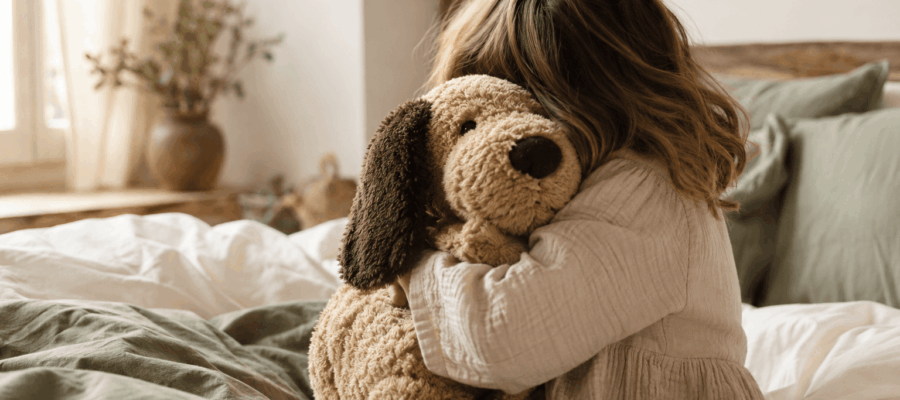
Many parents give a child a stuffed toy without realising how powerful it can become when it resembles the family dog. It is no coincidence that a child often asks for a cuddly toy that looks like their pet: this preference is tied to well-known attachment processes described by psychologists. What may seem like a simple toy can become a lasting emotional anchor, especially when it captures the features of a beloved dog.
Why a cuddly toy can extend the bond between a child and a dog
A child who grows up with a dog often forms a strong attachment very early in life. The dog becomes more than a pet: it is a playmate, a source of comfort, and sometimes a silent companion that helps the child feel safe. But a dog is not always available. It may be sleeping, outside, or simply in another room at night. That is where a stuffed animal modelled after the dog can play an important role.
Psychologists describe this as an object of transition, a concept introduced by paediatrician Donald Winnicott in 1953. Such an object helps bridge the gap between the reassuring presence of an attachment figure and the child’s growing independence. A toy that looks like the family dog does exactly that. It carries the image of the loved animal and gives the child something tangible to hold onto when they need reassurance on their own, especially during moments of separation, a move, the start of school, or a temporary absence of the dog.
Sleep: how a familiar plush toy can make bedtime easier
Bedtime often brings together all the small worries children feel during the day: darkness, silence, and being apart from their parents. A familiar plush toy acts as a signal of safety and can make it easier to settle down and fall asleep. It gives the child something soft to hold, focuses their attention, and makes the bed feel more welcoming.
Some models go a step further. A weighted plush toy applies a gentle pressure to the body, following the same principle as weighted blankets. This deep, comforting pressure can encourage relaxation and help active or anxious children drift off more easily. For a child used to sleeping near their dog, that sense of softness and closeness can recreate part of the animal’s reassuring presence.
How to choose the right dog plush: resemblance, materials, and safety
Not every plush toy will have the same effect. For it to play a real emotional role, it first needs to evoke the dog itself. A similar colour, the shape of the ears, or the look of the muzzle may be enough to trigger recognition in a child’s mind. Choosing a dog plush toy that closely resembles the family pet’s breed strengthens that bond even further.
Material matters just as much. A soft coat and a generously filled body encourage cuddling, while a machine-washable fabric is essential for an object that will be carried everywhere, slept with, and loved daily. Children do not treat comfort objects gently; they drag them, squeeze them, and take them from room to room. A plush toy that can be cleaned easily is therefore far more practical and more likely to stay in good condition over time.
Safety should never be overlooked, especially for younger children. In Europe, the EN 71 standard and CE marking indicate that a toy meets key requirements, including the absence of small detachable parts and harmful substances. Eyes and noses should ideally be embroidered rather than glued on, and seams need to be strong enough to withstand repeated hugs and washing. These details may seem minor, but they make a real difference in everyday use.
In the end, a well-chosen plush toy does not replace the family dog. Instead, it becomes a faithful extension of that relationship: soft, familiar, and always available when the child needs comfort. For a young child, that can be enough to make separations easier, bedtime calmer, and moments of uncertainty less overwhelming.
latest posts published
Dog Supplies: Essential Checklist Before Adoption (2026 Guide)
How to Understand Your Hamster’s Behavior

How to Feed an Unweaned Kitten –
Medium-Haired Cats: Breeds, Temperament, and Prices – Cat Breeds
When and How to Find an Emergency Veterinarian

Chocolate Labrador: This Secret Could Save Its Health
What Should I Do If My Dog Breaks a Leg?
The Modern Challenges Facing Farmers Today –
Healthy Dog: How to Spot the Key Warning Signs