
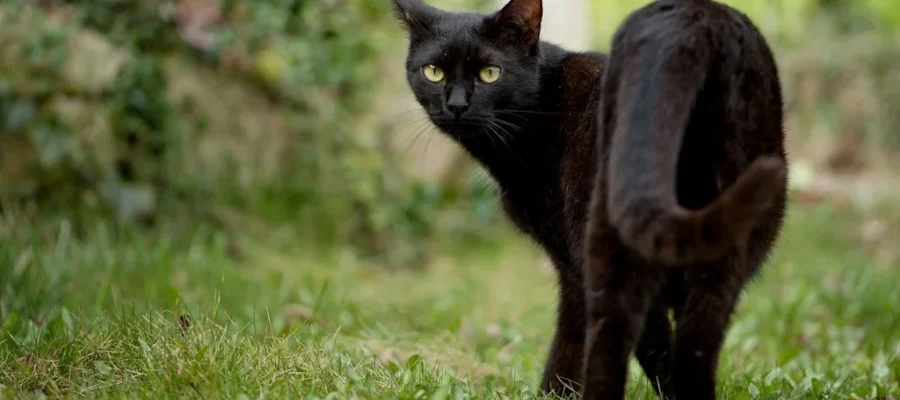
Black cats stand out for their natural elegance and their deep, glossy coats. Long surrounded by superstition and sometimes unfairly linked with bad luck, they are first and foremost gentle companions that are often highly affectionate. Several breeds can appear in solid black, including the Bombay and the European cat, each with its own temperament but sharing the same striking dark coat.
The essentials (TL;DR):
- A black cat is not a breed but a coat colour found in several breeds, including the Bombay, Maine Coon, and European cat.
- Its colour depends on melanin genetics, especially the B gene (black), the agouti gene, and the dilution gene, which can produce a grey-blue shade.
- Black fur can naturally show brown, copper, bluish, or “ghost” tabby markings depending on the light.
- White patches are linked to depigmentation genes, especially KIT, and may appear on the chest, belly, or paws.
- Black cats generally suit many lifestyles and are often sociable companions.
What makes black cats special?
The black colour in a cat’s coat depends on several genes involved in melanin production, the pigment that determines fur colour. Among them, the B (Black) gene plays a central role by promoting the production of eumelanin, the pigment associated with dark colouring.
The agouti gene (A) affects how pigment is distributed along each hair. When it is inactive (a/a), it prevents the typical tabby pattern from appearing, which can result in a uniform coat, including black.
The colour can also be altered by the dilution gene (D). When it appears in its recessive form (dd), it softens the black pigment and turns it into a bluish-grey shade, commonly called “blue” in cats.
In other words, black is not determined by a single gene. It results from the interaction of several genetic factors that influence both the tone and pattern of the coat.
Variations in black coats
Black coats can look different from one cat to another. A solid black coat is deep and even, with no visible markings. In some cats, so-called “ghost” tabby patterns can appear, revealing faint stripes that are noticeable mainly in certain lights or from behind.
Black fur may also show particular reflections depending on coat texture and lighting. Some cats have copper, brownish, or slightly bluish highlights, which can change with the light and during shedding.
White patches on a black coat
White markings on a black cat are linked to genetic mechanisms involving the KIT gene, which helps determine how pigment cells are distributed during embryonic development. Depending on how it is expressed, it can create areas that are more or less depigmented.
This depigmentation often appears in specific places such as the chest, belly, or paws. The amount of white varies greatly from one cat to another, ranging from a tiny patch to much larger white areas.
Which breeds can be black?
Many cat breeds can have a black coat.
The black European cat: the most common
The black European cat is known for its athletic build and bright eyes, usually gold or copper-coloured.
Recognisable by its round head and straight nose, this cat may sometimes have a few discreet white hairs on the chest. Its short, dense coat needs very little maintenance: a weekly brushing is enough to keep it looking glossy. In some cases, the coat may be long or semi-long.
With a sturdy constitution, this domestic cat adapts well to both apartment living and life in a house. Its balanced temperament and remarkable intelligence make it an excellent family companion. A skilled hunter, it keeps its natural instincts while remaining deeply attached to its home.
Santévet’s tip: If you want to adopt a black cat, shelters and animal welfare associations are full of them. Still affected by superstition, they are unfortunately among the cats most often abandoned and also among the hardest to rehome.
The Bombay: a cat with a pure black coat
Created in the United States in the 1950s, the Bombay cat has the look of a miniature domestic panther. Its coat is a deep satin black and remains uniform, with no reddish sheen in the sun, which reinforces its striking and elegant appearance.
Its paw pads and nose are also ebony-coloured, while its large copper eyes give it a vivid, expressive face. Its smooth, fluid movement recalls wild felines, which adds to its special charm.
In terms of health, the Bombay is generally a robust cat with a good life expectancy, although it may be predisposed to some respiratory or heart sensitivities, as with certain selectively bred cats. Regular veterinary check-ups help ensure long-term well-being.
The LOOF standard accepts only one coat colour for this breed: uniform black, with no colour variation. That requirement makes it relatively rare and sought after.
Did you know that cat health insurance can help cover veterinary expenses up to 100%, depending on the plan you choose? It is worth looking into.
Other breeds that may have black coats
The Maine Coon is admired for its impressive size and abundant coat. This giant breed can weigh up to 10 kg and has long to semi-long fur. In some varieties, the coat can be entirely black.
The Oriental can also be black, with its characteristic slender silhouette and large, well-developed ears.
The black Persian appeals to lovers of long-haired cats, with its flat face and dense, flowing coat. This breed needs daily brushing to keep its dark fur beautiful and rich-looking.
The Scottish Fold may also have a black coat, which highlights its distinctive folded ears and reinforces its unique appearance.
What is the black cat’s temperament?
Black cats often form especially strong bonds with the families who adopt them. True guardians of the home, they show affection by keeping an eye on comings and goings and often alert their owners to unusual situations with distinctive meows.
Their protective nature is especially visible around children. A black cat often accompanies the youngest members of the household in their daily activities, showing remarkable patience during play.
These cats express affection in their own ways: long purring sessions, kneading blankets, and the charming habit of following their person from room to room. Their reassuring presence brings real comfort, especially in the evening when they like to curl up beside their owners.
Are black cats sociable with other animals?
A black cat usually gets along well with other cats, provided introductions are gradual. A too-rapid introduction can create stress and territorial conflict, even in a gentle cat.
Living with dogs is also entirely possible. Early socialisation is the key factor: a kitten exposed to dogs from the first weeks of life often develops natural tolerance and may even form a real friendship.
Small animals such as rodents or birds are a different matter. A cat’s hunting instinct remains strong whatever the colour of its coat, and living together requires constant supervision from the owner.
Why adopt a black cat?
Every cat has its own personality, but in general a black cat is a companion well suited to different lifestyles, whether in an apartment or a house with a garden. It usually cohabits well with other animals and adapts easily to family life. A small everyday bonus: its fur is less noticeable on dark clothing.
These cats are also good hunters, with well-developed natural instincts, especially for spotting and following small movements. They may help reduce the presence of small rodents around the home.
A black cat is also a discreet yet present companion, and its company can bring a sense of calm and comfort to everyday life.
Price and budget to expect
Adopting a black cat from a shelter generally costs between 50 and 200 euros, including neutering, vaccinations, and identification. That is a very reasonable amount compared with the separate costs, which can add up to 400 euros.
Veterinary expenses are a major part of the annual budget needed to keep a cat healthy.
| Type of veterinary expense | Description | Estimated cost |
|---|---|---|
| Veterinary consultation | Routine check-up or occasional visit | 30 € to 60 € |
| Vaccinations | Initial vaccinations and annual boosters | 60 € to 90 € / year |
| Neutering / spaying | Recommended surgical procedure | 80 € to 150 € |
| Deworming | Treatment against internal parasites | 10 € to 20 € / treatment |
| Parasite control | Protection against fleas and ticks | 5 € to 15 € / month |
| Emergency veterinary care | Unexpected treatment or hospitalisation | 100 € to several hundred euros |
| Additional tests | Blood tests, X-rays, ultrasound | 50 € to 200 €+ |
How to care for a black cat
A black coat needs very little maintenance. Brushing twice a week is usually enough to remove dead hair and keep the coat clean and shiny.
Setting up a quiet grooming corner with a few suitable tools makes everyday care easier.
Maintenance costs to expect:
| Item | Use | Price |
|---|---|---|
| Brush | Coat care, shine | 10 to 25 € |
| Metal comb | Detangling and removing loose hair | 5 to 20 € |
| Grooming glove | Gently removes loose hair | 10 to 20 € |
| Cat shampoo (occasional use) | Spot cleaning | 8 to 15 € |
What should a black cat eat?
Like all cats, a black cat is an obligate carnivore. It needs animal proteins to function properly, including essential nutrients such as taurine. A deficiency can lead to serious health problems, especially involving the heart and eyes.
It is therefore best to choose food based on meat or fish, whether as quality dry food or wet food. A clearly identified animal protein source as the first ingredient, such as chicken, salmon, or turkey, is a good sign.
Cats naturally drink little, so hydration is important too. Wet food can help meet part of their water needs and reduce the risk of urinary issues.
Feeding budget to expect:
| Type of food | Description | Monthly budget |
|---|---|---|
| Standard dry food | Basic diet | 10 to 20 € |
| Premium dry food | Higher quality, easier to digest | 20 to 40 € |
| Wet food | Hydration + palatability | 20 to 50 € |
| Mixed feeding | Dry food + wet food | 30 to 60 € |
Need to talk about your black cat? Discover our pet health insurance offer to request a callback from one of our advisers.
The symbolism of black cats across cultures
What did black cats mean in ancient Egypt?
In the Egypt of the pharaohs, the black cat held a sacred place, embodying the powerful goddess Bastet. Its dark silhouette symbolised protection of the home and fertility.
Egyptian priests regarded these cats as divine guardians, capable of driving away evil forces. This belief was reflected in the myth of the celestial cat, an avatar of the god Ra, who fought the serpent Apophis every night.
Temples housed black cats that were fed the finest food. Their deaths led to grand ceremonies: careful mummification and burial in dedicated necropolises. This shows just how exceptional these cats were in ancient Egyptian society.
Superstitions about a cat crossing the road
Across Europe, beliefs about a cat crossing one’s path vary from one region to another. In Germany, a cat passing from left to right is said to bring prosperity, while the opposite direction is thought to foretell difficulty.
Scandinavian countries see the direction a cat takes as a message from the Norse gods. A crossing to the east announces good news; to the west, an imminent change.
In France, tradition says that a cat crossing the road at dusk reveals secrets of destiny. This belief survives in some regions, where people watch the cat’s pace closely: a quick crossing predicts an event soon, while a slow one suggests a time for reflection.
Why are black cats considered unlucky?
Persecution of black cats reached its peak between the 15th and 17th centuries during the major witch hunts. A medieval belief claimed that these cats had a special ability: they served as spies for their witch mistresses thanks to their sharp eyes in the dark.
Accusers claimed that witches fed their black cats through a magical third nipple. This supposed mark was used as “proof” in witchcraft trials.
During this dark period, thousands of black cats died on pyres alongside their owners. One particularly cruel practice was to throw them from bell towers during popular festivals, reinforcing the association between black cats and occult forces.
Black cats in art and popular culture
The famous Montmartre cabaret Le Chat Noir marked a turning point in the artistic representation of the black cat. Its iconic poster created by Steinlen remains a symbol of bohemian Paris and has been reproduced on countless decorative objects.
In literature, Edgar Allan Poe elevated the black cat figure through his eponymous short story, while Japanese manga reimagined it through characters such as Luna in Sailor Moon.
Film and television have also embraced this fascination: Salem, the sarcastic cat from Sabrina the Teenage Witch, won audiences over with his biting humour. More recently, social media has celebrated these cats through thousands of photos and videos, proving that their mysterious aura still enchants new generations.
What should you name a black cat?
When naming a black-coated cat, let its personality guide you. A playful, lively cat might suit Pixel or Flash, while a calm cat may fit Velvet or Onyx.
Names inspired by nature also offer lovely options: Eclipse, Night, or Cosmos evoke the natural elegance of your companion. For something more original, look to other languages: Kuro (black in Japanese) or Nox (night in Latin) bring a distinctive sound.
Choose a short name, ideally one or two syllables, because it is easier for your cat to remember. Try it out for a few days: your cat should respond positively when you call it.
Black cats may belong to certain breeds, but most are European cats or mixed-breed domestic cats. They are especially appreciated for their sociable and affectionate nature.
latest posts published

Pregnant Dog: How to Prepare for the Arrival of the Puppies?

Death and Inheritance Rights: Who Inherits Your Pet? What You Need to Know

Senior Dog Kibble: At What Age Should You Switch?

Which Dog Breeds Don’t Shed Hair?

Bringing Your Dog or Cat to the Casino: Is It Really Possible?

What Are the Most Beautiful Cat Breeds?

Why Does My Dog Close Its Eyes When I Pet Its Head?
How to Clean Your Cat’s Ears Without Stress

Sterilizing My Cat: The Real Pros and Cons